Tuesday, April 3, 2018

Meghan Pinson: "Novel Revision 101: DIY and Collaborative Revision"

Article by T.W. Fendley


Meghan Pinson, founder of My Two Cents Editing, outlined a comprehensive plan for taking a novel from the first draft to a finished manuscript at the Guild’s Feb. 3 meeting in a talk entitled “Novel Revision 101: DIY and Collaborative Revision.”

“It’s fine to write a terrible first draft...lots of people do that and turn it into a beautiful novel by the tenth or fifteenth draft,” she said. But the first step is to finish your first draft. “And don’t show it to people before you’re really finished.”

Then, she advised, let it sit for at least a month or two so you can forget how the story came out of your head. You want it to feel like someone else wrote it so you’ll be objective when you begin to edit.

Research

Whenever you’re not actually writing or revising, she suggested that you:
  • Research characters, settings, or occupations
  • Investigate target markets
  • Make a list of books on the shelf where your book would appear
  • Make a list of authors/titles/books that inspired you to write this one
  • Create a reading list of books with similar elements to yours (e.g. set in Montana), then study how description, point of view, etc., is used in those
  • Pull every book on writing craft that looks good to you in the bookstore or library , then skim them to find your favorites. Most books on craft tend to deliver the same advice from different angles, so find the ones that speak your language. 
Some of Meghan’s favorites include:
  • James Scott Bell, Plot and Structure; How to Write Dazzling Dialogue
  • Donald Maass, Writing the Breakout Novel
  • Robert McKee, STORY
  • Raymond Obstfeld, Novelist’s Essential Guide to Crafting Scenes
  • Linda Seger, Creating Unforgettable Characters

Revision process 

“When you begin revision, read your draft all the way through in as few settings as possible, making scant notes,” Meghan said. “See if you can figure out where it gets boring, and determine what’s going on there.” When you’ve done as many revisions as you can, then you’re ready to seek outside advice.

“You cannot fix everything, and no one person can ever find everything,” she said. “This is where critique groups, beta readers, and professional editors are helpful. When you’re ready for external feedback from other writers and readers, the easiest route is the most expensive one, and the toughest one is the most time intensive. In the middle are beta readers.”

Beta readers

Meghan says the best beta readers read widely in your genre and are drawn to your book organically. “Leave your relationships out of your writing process” by finding betas on Twitter, Goodreads, and Facebook. You can seek betas at any point in the process and ask them to do anything from catching plot holes to finding the last typos. This is a great chance to lasso early reviews before publication, too.

Give prospective betas a brief book description, the word or page count, and your cover (if you have it), and ask for honest feedback on your unpublished novel. Ask whether they prefer copies, Word docs, or ebooks; you can use Calibre to prepare a rough, free ebook. “Give them a timeline, then double it,” Meghan said. “If you want comments back within a month, tell them they’re due in two weeks.”

One interesting thing to find out is where beta readers stopped reading. “It’s very useful to know, although it hurts. It will be way down the line from where an agent would stop reading because betas feel a sense of obligation.”

You should provide a set of questions to guide your betas’ responses. “Hopefully, you will get three to six readers, at least,” Meghan said. “If you hear the same thing from more than one reader, that’s useful information; if just one reader comments that something doesn’t make sense but no one else says that, maybe let it go.”

It’s okay to ask other writers to be beta readers if no strings are attached. “Know what you’re asking, and know what you’re giving. It’s not an equal exchange if a beginning writer is asking someone who’s on their eighth book. But anyone who volunteers, just love them! … Fresh eyes are really good. You want enthusiastic volunteers.”

Meghan’s beta reader questionnaire is available on her website; she customizes it for each book she submits to her list of 60+ readers, and has invited guild members to adapt it for their own purposes.

Critique groups

“Critique groups are another great way to get feedback from readers,” Meghan said. “Each group has its own approach.” Choose a group that matches your genre, if possible, and make sure to ask for the sort of feedback you want: grammatical/mechanical markup and story critique are very different.

The St. Louis Writers Guild’s critique group coordinator, Jennifer Stolzer, said she acts as a matchmaker between interested writers. A form in the members’ section of the SLWG website collects information to share with other authors in the specified genre. On the guild’s Facebook page, writers can solicit critique partners without being a member.

Editing

“Never be nervous about asking a professional editor to define terms or to help you figure out the kind of editing you need,” Meghan said. She outlined some of the common types of editing and the average costs, ranging from proofreading ($25+ per hour) to a full critique ($1,000+ per book).

Copyediting or line editing to fix grammar, punctuation, and style should be one of the last steps, but it’s often the first step people want to take, she said. Editorial assessments, story critiques, content editing, and developmental editing are different ways of collaborating with an editor to improve the content of a book, and each tends to cost $60+ per hour, but different editors charge differently -- per page, per hour, or per project.

Different types of editing take more time than others, and Meghan gave ballpark estimates for a few different services, based on a 250-word page, which is the industry standard:
  • Proofreading: 10-15 pages per hour
  • Copyediting – 8 pages per hour
  • Line editing – 3 pages per hour 
She says if anything takes your editor longer than two pages per hour and you’re not independently wealthy, you’re better backing up and studying grammar before you hire a professional editor. She can help you with that, too.

Meghan Pinson provides expert editing, engaging critique, and fearless consulting to authors of novels and nonfiction manuscripts. She launched My Two Cents Editing in 2009 as a full-time freelance copyeditor and has steadily expanded to help her clients move from first draft to faithful readerships. Now her small crew of literary specialists provides comprehensive manuscript critique and a full range of editing services: editorial assessment, developmental editing, line editing, copyediting, proofreading, and post-editing cleanup. She leads writing and editing workshops and collaborates with her partner at Outrider Literary to guide authors through publication along indie, traditional, and hybrid paths.

Meghan is a member of the Editorial Freelancers Association, the Greater Los Angeles Writers Society, the Missouri Writers Guild, the St. Louis Publishers Association, and Reedsy (where you can see her portfolio). For more information, check out www.mytwocentsediting.com

Saturday, February 3, 2018

Justin Wells: How to Land an Agent

Article by Jennifer Stolzer

Justin Wells, a junior agent with Corvisiero Literary Agency, spoke to the St. Louis Writers Guild via webinar on Jan. 6, 2018, about 'what it takes to find an agent.' The event -- SLWG's first official webinar workshop – took place before an overflow group of about fifty assembled at the Lodge Des Peres and viewers both on Facebook and a private web meeting.

The first step is to write a query letter, which is an agent’s first impression for most writers. “Many agents have different views on what they want you to include in query letters,” Wells said. “This includes personal preferences, what they've learned to accept over the years based on queries they've seen.”

Start the opening paragraph with a hook -- an attention-getting sentence or phrase that introduces the main character, the conflict, and what is at stake in the story. “Never go in saying 'I'm seeking representation for this novel and general information.' That information is important, but that's not how you lead. Jump straight into your story.”

The second paragraph provides further information about those topics. “Story paragraphs don't need to be very long, especially if the agent requires as synopsis,” Wells said. “I want to immediately dive into your book. Being overburdened with general information, I'll either get bored or not make it to the meat of the query letter. Start with the hook, and I'll scroll down to see the general information about the novel.” Add the general information such as title, genre, word count, and comparison titles in the third paragraph, and in the fourth paragraph, write a short assessment of your past writing credentials, including previous publication experience.

“If you are querying a novel that has been self-published, mention your sales and how long it has been selfed,” Wells instructed. “No matter which avenue you take for self-publishing, you always need to have numbers and some kind of base to back that up. Most editors look for very high sales numbers. If we try and sell [a previously self-published novel] to a Big Five publisher, we're going to want to see tens of thousands of sales for a self-published book.”

Authors must also take their self-published book off of Amazon and other publishing sites, because those rights will be re-sold to the new publisher by the agent. If writers are pitching previously published work, it is important to include who published it and why the separation happened. An agent cannot take on work that is still under contract. “Make sure to mention that it was previously published, and you don't have access to numbers but the rights were reverted back to you so there's no conflict in contract.”

If you don't have previous writing experience, the fourth paragraph is almost optional, but it's good to include any writing credits, including unrelated self-published work, short stories, professional writing, or other public works. “Any publishing experience you have... is a way to show that you can write about different fields and levels of writing. It’s something to include in the biography section of your query letter,” Wells said.

It is also a good idea to personalize your query for each agent, which can be done in many ways. If the agent is one you pitched to in person, remotely, or through social media, you can mention where you met. Another way to personalize is to investigate their sales and clients. Mentioning a client they represent who you enjoy or a book they sold that is similar to your title are also ways to prove you have done your research and are aware of the industry. You don't have to personalize a query letter, but it's a nice touch.

Research agents before querying


However, the query letter is not the only first step, according to Wells. “One of the main downfalls I see writers do is that they are focused too much on their query letter and not enough on research and finding the right agent for them.” It's important to find agents who are the best for you and your work, are actively seeking clients, and have a good reputation in the industry.

Querytracker.net is one of many places to research agents. The website shows what agents are looking, what agencies they work, if they accept email or snail mail, and feedback from other writers. While praising Querytracker as a resource, Wells warned writers to be careful with the comments section. It gives a good indication of how agents conduct their business, but it is also an open forum where writers angry about rejection letters or other issues can vent their frustrations. “Always remember that there are a lot of situations that would prompt someone to leave a negative comment, so always take it with a grain of salt”

When it comes to new agents, Writer's Digest's “Guide to Literary Agents” page is one of the best places to go. The site features reputable literary agents who are new to the scene and where they work. While there is a risk to engaging a new agent, there are benefits as well. Wells explains, “New agents are building their list and actively seeking clients. You run into a situation with older agents that have been working for a long time -- some might be seeking clients, but it’s a very small number and they're very specific.” New agents may not have the sales an older agent has, but researching the reputation of their agency and success of the senior agents will give you an idea of what to expect.

Another resource is the Publishers Marketplace. It requires a monthly fee to join, and is more helpful for researching agents who have multiple sales. It offers a deep look into the agents’ history, including sales, editors and houses they've worked with, and what they are presently looking for. “There are many avenues you can take with this website, not only [looking at] agents, but editors and publishers,” Wells said. “If you feel you need that initial research, it's definitely something you can look into.”

AgentQuery.com is another website with valuable information. It is similar to Querytracker, but without the ability for authors to comment. It focuses on general information to help you catch red flags and be sure the agents you query are reputable in the industry, but focuses mostly on well-established veteran agents. To research newer agents, WritersMarket.com – a part of Writers Digest – puts out new agents alerts regularly. Writer’s Digest also publishes print books every year, such as The Guide to Literary Agents 2018, which lists details about current literary agents.

Jane Friedman's blog is another good resource. Prominent in the publishing world, Friedman has articles that are helpful for new and experienced writers. How to Find a Literary Agent For Your Book is a particularly good article for writers looking for agents. Jane Friedman's Twitter account is also very helpful. Don't overlook social media

“Twitter is really your best friend as a writer,” Wells said. “You don't have to be incredibly active on Twitter, but as long as you have an account to take part in writing events and pitch events, it will be really helpful.” Pitch events on Twitter provide writers a chance to seek representation through social media.

Carissa Taylor's blog (carissa-taylor.blogspot.com) has a good list of Twitter events and other resources. PitMad is the biggest yearly event, and a popular place for agents to find new projects and clients. Pitch Wars is a multi-month Twitter event where writers sign up, pitch, and hope to be brought on by mentors to help prepare their manuscript for an agent review round. At this point of Pitch Wars, agents read and comment on posts or request works from writers. “For Pitch Wars, they'll automatically request a full manuscript,” Wells said. “There's a lot of competition for agents to sign some of the people...Last year I requested to represent two authors, one of which I lost to Susie Townsend, which is not a bad agent to lose a client to! Lots of success in past years through pitch wars.”

Send query letters in batches


After the research is complete, it is time to send the query letter to agents. “You always want to personalize query letters,” Wells said. "But it's okay to copy/paste the body of the query in emails to multiple agents. Just make sure you change the names!”

It is a good strategy to send query letters out in batches because it can sometimes take a long time for agents to read through their inboxes full of queries. “I've gotten a lot of people who get really frustrated if I don't reply to queries in a week or two, and that's just not feasible,” Wells said. “I can spend five to six hours a day and not even get through a months' worth of queries. It's definitely a long process. You have to be patient.”

Some agents have a 'no reply means no' policy, meaning writers will never hear back about rejected queries. Others send form letter rejections. A form letter is a pre-written letter copy/pasted to writers with a small degree of personalization, which is what Wells does with his rejections. “If there's something blatantly obvious that needs to be changed in the pages or query letters, I'll note that, but I simply don't have time to do a personalized critique for every query letter,” Wells said. “I try to construct my form rejection in a way that the author can still gain something from it – information where they can find beta readers or critique partners so they can improve. I always want to make sure I'm providing something beneficial for them.”

Once you've caught the interest of an agent, they will request additional material from you, such as a partial or full manuscript. You could receive a personal or form rejection at this stage as well. If the work moves past the request stage and to an offer of representation, the agent will make an appointment to talk on the phone.

Preparing for “the call”


There are important things to consider when preparing for an agent phone call. “If you've received a request from an agent – an agent you really want to work with – you need to start doing a lot of research on the side,” Wells said. If a copy of the potential contract is not sent to you right away, make sure you ask for one to look over. Check the percentage of sales the agents would be getting. Most reputable agencies charge 15 percent of sales. “This is standard across pretty much all agencies,” Wells said. “Stay away from those who require money up front. Any reputable agent or agency will not get paid until you get paid.”

Also ask the agent for the contact information of one or two of their clients . Make sure to ask them about the agent’s communication style, any challenges they may have encountered, and other things you may experience if the agent represents you. “Agents should be happy to provide you emails of past clients. If an agent is not willing, there has to be a reason. It's a good way to weed out some concerning things about an agent.”

Ask about the agent's policy on representing future work. Authors often write in a variety of genres for many different audiences. Be up front with what future projects you hope to pursue. “I only represent certain age ranges,” Wells said. “I represent young adult and limited adult. If a client pitched me a young adult contemporary, then comes to me some time later wanting to publish an adult romance, I want to make sure I have a contemporary agent to refer them to. I never want to take on a project and not be able to fully help the author.”

Another important topic to discuss over the phone is what would happen if an agent leaves their agency. Most agency contracts state that if an agent leaves, their clients will pass to another agent within that agency. If no agent in the company decides to pick up that client, the agency can release the contract and the author is welcome to seek representation elsewhere. “You want to stay away from situations where you're stuck with one agency,” Wells said. “You always want to have some way out.” Most agencies will work those conditions into the contract. Agents might leave agencies for a variety of reasons. “Most of the time, separations are not caused by anything negative or bad. Usually it's an author or agent needing to go a different direction. There are situations where negative things lead to separation from an agent. That's a big reason why you want to make sure you're reading the contract and asking things you need to ask during the phone call.”

Most agent phone calls when offering representation last about an hour. Once you've had a phone call and done the research, you might have multiple offers on the table at once. This is the situation where the relationship starts coming into play. “If you found you really connected with certain agent during the phone call, that's something you want to take strongly into consideration,” Wells said. “When you sign with an agent, you are agreeing to work with them for the life of the work. It's a big commitment... so being able to connect and communicate well with an agent is something that's very important.”

Writers need to communicate with their agent not only as a business partner but also as a friend and collaborator. Many writers text with their agents daily, sharing details about their work and their lives. “That's one of the things that early on I decided was really important to me, personally,” Wells said. “You need to be able to go to your agent and say 'hey, I have this idea, what do you think?' and if the agent isn't willing to talk you through that, it's something you really need to take into consideration.” Any agent no matter how big or small should really be able to invest a lot of time into their clients, but remember there is still a line not to be crossed when it comes to personal matters and personal time. You can trust an agent with personal information and build a friendship, but remember to stay respectful. They are people, too. Remain open, but professional.

Finding the right agent for you is not an easy process. Constant research to find and assess agents who represent your project's genre and age group is a must. Patience and persistence are required, considering the volume of queries the average agent receives. Choosing an agent is a long-term commitment on the part of both the agent and the author, but don't get discouraged. “Search for an agent,” Wells said. “No matter how long you've been searching or how long you've been writing, there's always the possibility that an agent will love your work and want to sign.”


NOTE: If you have interest in reporting on workshops such as Justin Wells' webinar on agents or submitting other writing-related articles to the Scribe blog, contact the editor at news@stlwritersguild.org.

Tuesday, January 9, 2018

Young writers recognized at Guild's holiday event

Article by Lauren Miller

Each December marks a celebrated tradition here at SLWG, when the winners of our Young Writers contest, held each year in August-October, are invited to read their entries at our December meeting, followed by a Guild potluck of tasty sweets. This year also featured an open mic where Guild members read their work.

As a refresher on the contest’s rules (full details on our website), the writers in two grade divisions (4th-5th, and 6th-8th) must write a short story-- no fewer than 250 words, no longer than 500 words-- beginning with a prompt provided by the Guild. This year’s prompt was “The book had no words…”.

In the 4th and 5th grade division, the event recognized the following winners:

·         Honorable mentions were given to “Spellbound” by Gavin Daengsurisi, “The Grayish Splinter (A Horror Story)” by Madeleine Meyers, and “The Book of an Other” by Courtney Wu.

·         The third-place winner was “The Disappearance” by Liane Dunlap.

·         The second-place winner was “The Secret” by Zoe Schnadower.

·         The first-place prize in this division was awarded for “The Big Secret” by Olivia Johnson.

In the 6th-8th grade division, the event recognized the following winners:

·         Honorable mentions were given to “Silent Eyes” by Keira Makalintal, “The Book of Secrets” by Emma Shuler, and “An Eerie Silence” by Shruti Panda.

·         The third-place winner was “A Final Breath” by Jarom Robeck.

·         The second-place winner was “The Diary” by Elizabeth Kadyk.

·         The first-place prize in this division was awarded for “A Hollow Victory” by Jarom Robeck.

Contest participants were allowed to submit up to two short stories, and all entries were judged blindly by St. Louis Writers Guild board members. Congratulations to all of this year’s winners, and especially to Jarom Robeck for his outstanding accomplishment of having two winning entries. We look forward to next year’s contest!


Madison leads writers at Nov. 4 workshop on “Crafting a Successful Synopsis”

Article by Lauren Miller

Photos by Steven Langhorst


Shawntelle Madison, who began seriously pursuing writing in 2008, knows a thing or two about crafting a synopsis that will sell your book, having written a number of contemporary and paranormal romances, some horror and urban fantasy, including some bestsellers.

At the Guild’s November 4 workshop, attendees were treated with her guide “Crafting a Successful Synopsis.” They also received copies of sample, successful (novels that were eventually published) synopses from other authors for writers to take home, ready and study. So, for uninitiated of writers who have yet to craft their first synopsis and for seasoned writers looking for a refresher, let’s now dive in to the nitty-gritty of creating a standout synopsis.


Formatting Your Synopsis


Always check the agent and editor submission guidelines! Double-space your synopsis unless the submission guidelines specify differently. Use 12-point font in either Times New Roman or Courier. Avoid fancy fonts (they don’t impress anybody). Your synopsis should be written in the third person. Format your synopsis to include your name and contact information at the top of every page – that way if they get out of order or mixed in with any number of other authors’ synopses, the editor or agent will still know which one is yours. The length of your submitted synopsis will vary depending on the requested length (anywhere from one, two, three, five pages or more) and sometimes, you may get asked for a chapter-by-chapter breakdown of your entire novel. Be ready for anything.

The Building Blocks of a Successful Synopsis


Madison recommended Debra Dixon’s Goal, Motivation, Conflict for its description of the fundamental building blocks of conflict – goal, motivation and conflict (the GMC’s).

“Before I start writing a book, I will create a GMC chart […] and create a GMC statement – your protagonist wants/needs/has to do a particular goal because of the motivation, but must face conflict. Oftentimes, I will ask myself this question for individual scenes [too],” Madison said. Knowing these three elements, and bearing them in mind throughout the development of your synopsis, will help you determine what your book is really about. When a book or scene feels like it rambles and doesn’t go anywhere, it may be because it is lacking any or all of these three components.

Shoot for writing a synopsis in different word lengths: 25 words or less, 15 words or less, 10 words or less (your tagline). Madison led participants through an analysis of a synopsis of a story to identify the main characters, the major plot points within the synopsis, and what the GMC for each of those characters was. A synopsis is not that different from a book blurb in that it will touch on some of the major plot points and identify who the characters are, but it should be succinct and always progress your novel’s conflict. One key difference is while a book blurb hints at the conflict but doesn’t give away the ending, a synopsis should disguise nothing and give away the whole plot.

Begin your synopsis with the introduction into your story world and immediately launch into the inciting incident—the moment that kicks off the conflict for your characters. Based on the sample synopses provided by Madison, author Jeannie Lin took the approach of including her GMC statement within the introduction of her synopsis. By contrast, author Amanda Berry began her synopsis with an introduction of her characters. Madison described her own approach,

“When I am writing a story, the beginning takes forever because I am always asking myself, where does the story start? It’s too easy to give a grocery list of this happened, then this.”

Your opening sentence should include a hook that will capture the attention of a reader, agent, or editor. This is your one opportunity to stand out. Your synopsis is also the place to capture your story’s tone (e.g. dark, light, etc.) and give your audience an idea of your writing voice. A synopsis will not necessarily be in chronological order, but it should reflect your book as a whole. 
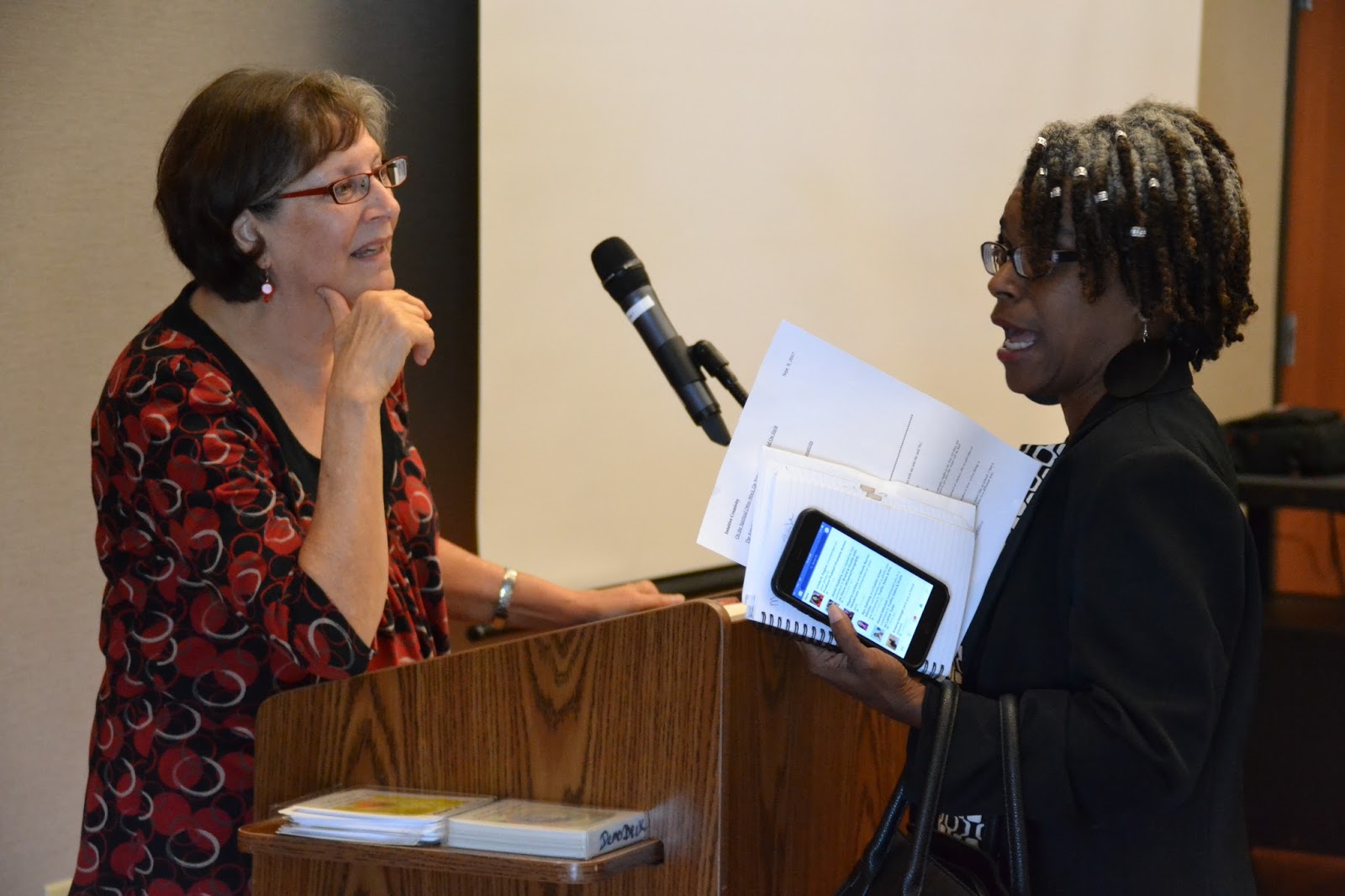
Madison discusses writing with a participant.


Protagonists & Plots


The body of your synopsis should be a progression of your main character’s GMCs – what is their main goal and motivation during the conflict? What is the internal flaw that is standing in the way of their success, which they will need to overcome (positive ending) or not (tragedy) by the end of the story? Don’t forget about this flaw when you’re writing your synopsis or your book. In a series, there will usually be an overarching conflict, and the protagonist may not change very much, but there will still be change around them.

“To avoid writing a dry piece of toast, focus on the beginning state and the ending state of your character throughout your synopsis,” Madison said. Her questionnaire, available to participants, led attendees in a step-by-step development through the synopsis process, hitting on the major plot points. To see how this is done commercially, look at any number of film breakdowns available online, such as the ones done by book doctor, Michael Hague.

All plot points should be included in your synopsis, from the opening sentence to the resolution. Take your synopsis, chapter by chapter, through each of the major moments in your novel. What are the turning points when something changes with the protagonist’s goal, motivation, or the conflict? Remember, you want to focus on the primary characters who are propelling the plot forward. Just like in a book blurb, the secondary characters can distract and clutter the narrative. As Madison said, “Condense. Condense. Condense.”

Madison recommended “The Novel Premise,” a useful worksheet in Lynn Viehl’s Novel Notebook, which may help you summarize your material. For a refresher on plot points, check out K.M. Weiland, who has a number of infographics on her website covering timelines for each of your novel’s critical junctures (www.helpingwritersbecomeauthors.com).

By the end of your synopsis, all the loose threads should be wrapped up and tied in a bow. There should be no unresolved subplots. For a series where the subplot or unresolved story thread is resolved in a future book, add an additional paragraph explaining this to your editor or agent so it’s clear it’s not just been forgotten. It may also be prudent to have someone you trust review your synopsis. Another pair of eyes may pick up on something you’ve missed. Madison uses this technique with her own work, showing it to a few, trusted critique partners before it’s ever shown to someone in the publishing industry.

Concluding Thoughts


Writers who embark upon writing a synopsis may find the process of consolidating a 90,000-word manuscript into a few pages, or worse, a single sentence, without losing the substance of the story, to be incredibly daunting. However, this exercise – besides being necessary in pursuing an editor or agent – does help the writer clarify the fundamental elements of their story. There is no room for hiding in a synopsis. If something is broken in your conflict, it will stand out. Some professional authors will even write the synopsis first and submit it to an agent before they write a single word of the novel. A synopsis is that powerful. By learning to harness the potency of a well-written synopsis, you can improve your chances at polishing your manuscript’s finer points (don’t forget about those GMCs!) and avert any potential plot disasters.

For more on these topics, please visit Madison’s website, www.shawntellemadison.com, where she has a free GMC Wizard and a Synopsis Wizard to help you develop your story.

Speaker Bio:

Shawntelle Madison is a web developer who loves to weave words as well as code. She’d never admit it, but if asked, she’d say she covets and collects source code. After losing her first summer job detasseling corn, Shawntelle performed various jobs—from fast-food clerk to grunt programmer to university webmaster. Writing eccentric characters is her most favorite job of them all. On any particular day when she’s not surgically attached to her computer, she can be found watching cheesy horror movies or the latest action-packed anime. She lives in Missouri with her husband and children.

Sunday, December 31, 2017

Liz Schulte: Taking your self-publishing career to the next level

Article by Jennifer Stolzer
Photos by Steven Langhorst

“I never wanted to be a writer,” Schulte began on October 7th, 2017. “I thought, 'I don't want to jump through hoops to find an agent or publisher, but if I could take control of this ship, I would.'” Liz Schulte has written and self-published over 26 novels since 2012. Going from a $2,000 loss at the start to surpassing her work income and making independent publishing her full time job. It took a lot of hard work and experience, some of which she had time to share with the St. Louis Writer's Guild, including how to manage time, find readers, and strategize marketing.


Step 1 is always putting words to the page. Schulte has a goal of 2,500 to 3,000 words a day. “Some days it's harder than others,” she said. “One book a year doesn't count. You need to be publishing constantly. It doesn't matter how many words you write in a day as long as you write. Even at 50 words a day you will finish your book.” Quality is not sacrificed for speed. Schulte does two to three drafts per book and hires an editor to make sure the final draft is top-notch. Although, she's tried all sorts of methods of plotting, experience has taught her to follow her characters and plot a couple chapters at a time. When she encounters writer's block, she turns to flash fiction. “I find a sentence or a prompt or picture and set a timer and write a little fiction about it and that gets me writing and then the words are there and I write.”

Schulte writes paranormal romance, mystery, and fantasy. She recommends writers who are writing series to write all entries in the series at once so that they can be released together. Readers want a complete series, and it allows the first book to be reduced to free as a marketing strategy to catch new readers. Free books distributed through sites like Smashwords and Instafreebee are one of many strategies for broadening an audience.

Another path to readers is through social media websites like facebook, instagram, snapchat, and twitter. “Social media is not the be all and end all,” Schulte said. “People can pick up when you don't want to be there. When you go on social media, be prepared to be their friend.” Readers want to know about the authors they read, and sharing about personal topics can help foster a community among writers and their readers. “I like to talk about my dogs, scary movies, and Jane Austin because that's what I like,” Schulte shared as an example, “and readers tend to have a lot in common with me because they like my books.” She also leads an online fan book club that has grown to four-hundred members. Schulte also fields her readers for ideas, often in the form of contests. One of her series has a clever motif for titles, so she invited her readers to suggest options in exchange for prizes like early access to books or naming a character. “We have fun,” she said. “It's a community. And forming that community is very important.”

Advertising is another way to attract new readers. Plastering ads on social media is not a good strategy. “Social media is a great place to build community, but not all readers want to talk to the authors they read,” Schulte said. Ads through portals like Bookbub can reach lots of readers at once, but can be very expensive. For this reason, advertisements and promotions like free book giveaways are best utilized by authors with many books under their belt, so that new readers have a wide library to sample from when they click through. New authors with only a couple books should instead focus on community and building a newsletter list.

Every writer should start building an email list for newsletters. “Open rates aren't extremely great,” Schulte admitted, “but if you build the list naturally you'll have a much better read and click-through rate.” She has one newsletter for all readers regardless of genre, and pushes announcements about all new releases. In 2016 she used this newsletter to construct a street team. She selected ten members to receive a gift bag and a copy of her newest book in advance. In exchange the street team was asked to give feedback on social media and reviews of the book when it came out. “I wanted real readers, not people who wanted something for free,” Schulte said. “Authors complain that 'my street team isn't leaving me reviews.' Life happens. You aren't paying them. Always treat your street team and your readers with a lot of respect.”


Listings on sites like Amazon and Goodreads are also important. The book cover is the first impression a reader has of book. It needs to tell a story and communicate to readers the tone and genre they are going to find in the book. “Know what your genre look like and who the successful authors in your genre are. See what their covers look like,” Schulte said. “If they're selling they're selling for a reason.” Schutle employs many different cover artists and designers to help tailor her books to the proper audiences. An illustrated cover is a great fit for one genre and not another, so although Schulte's wide range of books are promoted in the same newsletter and on the same media streams, they'll still appeal to the audience she is targeting.

The blurb on the book listing is just as important and Schulte had a list of helpful tips to help craft the perfect blurb: 
  • Pick one or two character names, avoid place banes unless they are familiar like New York City or Chicago. Even if the name of the world is important to the story, it is a nonsense word to a new reader unfamiliar with the series.
  • First line show how character starts out. Establish something about the character that distinguishes them from other characters.
  • Include the Inciting Incident that starts the adventure in the opening paragraph.
  • Second paragraph show rising actions and complications to the protagonist in two to three sentences.
  • Third paragraph explains the stakes and what happens if the main character fails to prove to readers why they should invest in the story.
  • Always end with a hook that makes viewers want to read more.

Making a career out of writing is not easy, but far from impossible. “I had to treat it like a business,” Schulte said. “Plan for writing like you're going to be successful. Start your LLC early. Get everything in line. I just want to make a living. I just set goals.”

If guild members would like to hear more wisdom from Schulte's career in independent publishing, they are welcome to a complimentary nineteen-page supplemental handout. [Email information redacted for privacy of author -- guild members, please contact news@stlwritersguild.org for contact details.]

Saturday, December 2, 2017

Weltman shares ways to tap into your intuitive creativity

Article by Jennifer Stolzer.
Photos by Steven Langhorst.

Deborah Terra Weltman helped writers tap into their intuitive creativity during an interactive workshop Sept. 9. She shared her personal experiences, as well as ideas from Julia Cameron’s 1992 book, The Artist’s Way. 


Deborah finds joy in creative work of any kind, especially work that inspires personal and spiritual growth. She adores creative problem-solving, magical places, “treasure hunts,” and imagining from new perspectives. She defined “intuitive creativity” as “being taught from within” rather than looking outside yourself for guidance. 

 “I always wanted to be a visual artist,” she said, “but I remember thinking I wasn’t good enough, even in grade school.” Because of that, she didn’t take art classes, which meant she didn’t have portfolio when it came time for college. “So I got a degree in psychology.

Later, after taking art classes as an adult at the community college, Deborah realized she had a particular artistic style. “I remember in a life-drawing class, at end of the period, it looked like we were all drawing different people but we were drawing the same model. I thought, ‘How is this possible?’ By the end of semester, we could recognize who had done each drawing, could easily see their individual style.”

She built up a portfolio and got accepted into Webster University, where she earned an art degree and teacher’s certification. “I focused on creative mindset – we all need to be able to think creatively.”

Morning Pages


Exhausted, after a single year of teaching in public school, she went into picture framing as a way of getting back into doing art while using creative problem-solving skills. Along the way, she started doing one of Julia Cameron’s Artist’s Way techniques: “Morning Pages.” Each day, you write three pages in a journal, to clear your mind so creativity can flow.

“I’ve journaled prayers, to-do lists, written my thoughts on what I was reading. Usually about three-fourths of the three-page requirement in, I don’t know what else to write. I do what Julia Cameron suggests for that: I simply write, ‘I don't know what to write’ over and over until something shows up in my mind. It’s a meditative practice and something always pops through,” Deborah said. “I often have the experience of feeling an opening. And when that next thought comes, I write on that.”

That is how she become a writer. One evening as she was getting ready to go to bed, Deborah had the feeling that an idea wanted to come through. “It was the beginning of a story. That was a nice surprise.”

The other two main components of The Artist’s Way are the twelve weeks of readings and exercises in the book and the Artist’s Dates. Deborah found it helpful to do the work with a group of friends. The eight regular attendees in the first group took turns teaching, doing one chapter every two weeks. “Each of us had our own teaching style,” she noted. 

The readings introduced concepts such as “poisonous playmates,” “crazy-makers,” and
"going sane” -- that’s when you start to do what’s important to you instead of doing what you “should.”

“From The Artist’s Way, I learned to be willing to be a bad artist—a beginner,” she said, adding “after all, not many people are born able to write novels."

Also from the book she learned to look at jealousy as a way of getting information about what one wants. “Pay attention – it (jealousy) will tell you what’s exciting and meaningful to you.”

Similarly, she suggested relabeling “failures.” For instance, someone in a cooking class had Jell-O that wouldn’t jell. The instructor said, “Then it’s not Jell-O, it’s strawberry sauce; serve it on ice cream.”

From the “time-travel exercise” in The Artist’s Way, Deborah identified old enemies of her creativity.  “I was shocked to remember my grade-school art teacher who said my project wasn’t good because green and purple didn’t go together. And years later, in community college – I was about thirty at the time and not quite as susceptible – my instructor said ‘you can’t do that,’ about my creative idea.  I knew he said that because it was something he couldn’t do.” Later Deborah learned of an artist who had done exactly what she had earlier envisioned. It was possible!

Filling the Creative Well


The Artist’s Date, the third component of The Artist’s Way, brings joy and creativity together: you go by yourself, to do something you find interesting, to fill up your creative well. “Some of my Artist’s Way friends had much better creative-well-filling ideas than I did – like taking a blanket to the park and lying down to cloud-watch. Others would go to events found in the Riverfront Times; one loved to go to Disney cartoon movies, even at the risk of being stared at as the only adult there in the theater without a child.”

Deborah quoted Julia Cameron, who wrote, “Focused on process, our creative life retains a sense of adventure. Focused on product, the same creative life can feel foolish or barren.” And “It is a paradox of creative recovery that we must get serious about taking ourselves lightly. We must work at learning to play.”


Shirley MacLaine’s 2001 book The Camino about walking the 500-mile Camino de Santiago trail across Spain particularly intrigued Deborah, but she didn’t move forward on the inspiration until the year she was to turn sixty. 

Deborah wrote morning journal pages regularly. “One day as I was I was doing my morning pages it came to me that if I didn’t do the Camino walk that year, I probably never would.”  This thought was followed by a response from beyond Deborah: “…and your life will be forfeit.”

 “I went “huh?” – I was pretty freaked out … but I kept writing pages, thinking about ways I could make this trip happen.” She asked her Artist’s Way group for help and they had good ideas. “At some point, I realized I’d have to do fundraising and would have to ask for help. One night, after an Artist’s Way meeting at my home, I saw that one of my friends had left a check on my pillow with ‘pleasant dreams of the Camino’ written in the subject line.”

“Before the Camino, I had so many fears, such as ‘Will my body be up to the task of walking twelve to fifteen miles per day?’ I didn’t have anyone to ask, so I used a technique called automatic writing to dialogue with my body about what it needed to be able to do the Camino,” she said. “I do think answers came from within me, as well as some from outside of me – some answers spoke to what I would experience while on Camino... experiences that had yet to happen.”

Deborah demonstrated the technique she had used to dialog with her body, automatic writing, also called direct writing. She described it as a way to access what some might call the subconscious or a higher source. 


Automatic Writing Exercise


Exercise: On your paper write: “Q” for QUESTION. Then write a question that has some meat to it (what if, why, how…), not a “yes” or “no” question.

Write “A” for “ANSWER”, then close your eyes. Take a breath, let it out. Then in your mind’s eye, visualize a gray screen. Don’t try to remember your question.

When a few words come into your mind, write them down,  then close your eyes again and go back to the gray screen. 

Keep doing that until the flow of words stops. Then ask, “Is there more?”

When the flow of words is complete, then, and only then, look at what you’ve written.

“Instead of hearing words, you may see words as if written on a chalkboard, or you may have a feeling in your body … sometimes the first answer will offer another question,” she said. 

Another way to access creativity is JOURNEY WORK. Often you use a rhythmic sound like drumming to take you to another place with an animal ally or a teacher to learn a lesson or understand something specifically. Some people when journeying have dialog with animal allies or teachers, but Deborah said she had physical experiences. For instance, on a journey to a sacred pool where salmon swam, suddenly she realized she could see from both sides of her head like a fish instead of through forward-facing human eyes. She hopes to be able to use this insight in her creative work.

She described two ways to access DREAM WISDOM. On a notebook by your bed, record the date, then write: “I will remember my dreams.” When you wake, you may remember “a corner” of a dream, which can act as a thread to help you pull the whole dream back.

Another way is to record the date and then: “In my dreams tonight, I would like guidance on …”

In the morning, write down what you remember. It may not always make sense right away. Dreams are symbolic and may need translation, but symbols are often universal. Using them may add another level to your writing

“If you are journaling or writing dreams, you will begin to notice synchronicities in your life,” she said.  “For instance, you may see a bumper sticker on the car in front of you at the same time the radio announcer says the same words.”

You may also want to pay attention to symbols in your body. For instance, constipation may indicate fear of letting go, pains in neck may refer to specific people, or you may be itching to get away. “If it’s meaningful to you in some way, it may work in your writing, too.” 

Other techniques to open creatively may included:

·         MEDITATION: in a meditative state, ask for guidance from a favorite author. Or, see if story ideas come.

·         Consider story titles which can be important, can sell the work.

·         Critique groups can provide useful input. Julia Cameron says that good criticism is that which is greeted with an internal “ah ha” and which leads to a new and valid path for your work.

·         You can create a “RANDOM IDEA Card Deck.” If you get stuck in your writing, pull a card. See if what you’ve written brings up ideas that will work in your story.

Round-Robin Storytelling


Exercise: To illustrate this technique, Deborah gave everyone a notecard and said to write down a situation. The notes were placed face-down in the center of each table. The participants were divided into groups to do “ROUND-ROBIN” Story-Telling. One person started a story, told it for a short bit and then “threw” it, perhaps in mid-sentence, to the person on their right. Whenever a person felt stuck as to where to take the story next, they could pick up a “situation card” for inspiration. 

Deborah also told the true story of two bestselling authors who discovered they had independently come up with the same story idea -- an Amazonian rain-forest business venture gone wrong, involving a long-suffering spinster employee who is quietly in love with her married boss, and sent on his behalf to the rainforest to handle the fiasco... also a love story.

“The point I took from this was that stories are alive,” Deborah said. “Ideas are alive. They’re floating around in the ether, and they visit a lot of people. If an idea comes to you, grab it… If you put it down, the Muses may take it to someone else.”

Deborah did get to go walk the Camino. While in Spain she journaled daily. “The Camino was a fabulous adventure. My life is NOT forfeit!” The daily journal entries became the foundation of her upcoming book, Camino Lessons: Losing 21st Century Fears on an Ancient Pilgrimage Trail (due out from PenUltimate Press this fall). Deborah teaches classes in “The Artist’s Way,” “Treasure Journaling,” and “Realizing Big Dreams” at the local community college and other venues. She is also the author and illustrator of two 75-card decks: “A Seeker’s Guide to Internal Paradigm Shift, What if…? Cards" (questions to guide and bless your day) and "A Seeker's Guide to Money and Abundance, What if…? Cards” (questions focusing on peace and plenty). View a sample of her “What if…? Cards” online at: www.whatifcards.com or contact Deborah at: terraartframe@sbcglobal.net

Friday, December 1, 2017

Critique groups help writers make their stories the best they can be

Article by Jennifer Stolzer.
Photos by Steven Langhorst.

Critique is essential to any writer’s betterment, but receiving criticism on one’s hard work can be a difficult thing.

“Remember that the goal of critiques is the make the piece the best it can possibly be,” said author/illustrator Jennifer Stolzer during the Aug. 5 workshop. While having pride in one’s work is good, it’s important to remember that first drafts are seldom perfect. 

Jennifer gave an overview of the Guild’s critique group program, which she coordinates. Describing it as a matchmaking service, she said her goal is to match writers with others from similar genres and writing levels.


“Finding the right people is important,” she said. “Generally, you wouldn’t want to pair a brand new writer with one who has published several books.” The Guild’s website, www.stlwritersguild.org, has a form in the Members Room that guides you through the application process. The password is listed each month in the President’s email or request it from: president@stlwritersguild.org

While variety among the members can provide valuable insights, she suggested limiting a critique group to similar genres. “And have guidelines on how to add and remove people from your group.”
When it comes to the actual feedback, one key skill is learning how to handle conflicting advice from your critique partners.

“One person may want more specifics in a scene, while another may want you to leave more to the reader’s imagination.” You can’t do both, so she advised using discernment. “It’s not a checklist of things to do … You don’t have to do everything your critique partners say, but do consider what they tell you. Take the best (advice), and leave the rest. Remember, you are the master of your own castle.”

 Noting that critique partners generally review only one section or chapter at a time, she suggested,  “Think of your work as a whole.” A comment about the need for more specifics may stem from another part of the story, such as a need for more description when the character is introduced, whereas the descriptions in the current chapter may be fine.

Using the “sandwich method” of critique can be helpful in many kinds of situations, not just writing. “You start with a positive comment, then offer your critique, and end with a constructive suggestion.” Ideally, you’ll prompt the writer to fix their own piece and think it’s their own idea. “You make them smile, make them sad, then make them smile again – and that will make them more excited about fixing the stuff in the middle.”

“Simply saying ‘this is bad’ isn’t helpful to anyone, and it’s also mean,” she said. Comments need to be specific and actionable, such as “I think the story actually begins in the second scene.”

To get the most from the critique process, learn to listen without being defensive.


“Be aware of your own personal preferences,” Jennifer said. “Don’t look for things that are wrong—look for things that need improved. Just that shift in mindset helps.” When you receive feedback, keep in mind that their goal is the same as yours—to improve the story.

“As writers, we can never get the ‘first-reader’ perspective,” she said, which is one thing critique partners and beta readers provide.

She shared a handout entitled “Beta Reading Worksheet” from Jami Gold, http://jamigold.com/for-writers, that offered questions to consider when reviewing your own or someone else’s work, such as:

Does the manuscript begin in the right place?

Do the characters’ goals seem believable, with well-drawn and appropriate emotion?

Are there enough stakes and/or tension throughout to make it a “page-turner?”

Does every scene add to and seem important to the story?

Do the details enhance rather than distract from the story?

Are characters’ voices consistent and distinct from one another?

Does the writing “show” with the senses, using “telling” only as appropriate?

Does the story deliver on the promise of its premise and opening scenes?

Do any sections take you out of the story? (Mark in manuscript.)

She concluded the workshop by handing out a few pages of a story to edit, giving participants the chance to try some of the techniques she had discussed.

Jennifer—who is also the Guild’s secretary--lives and works in St. Louis, MO. She holds a degree in digital media and animation from Webster University, and uses this skill set to create bright and engaging characters in both pictures and words. Her illustration company, Jennifer Stolzer Illustration, has served the St. Louis area and its authors for seven years. Find samples of her work at www.jenniferstolzer.com or on Facebook under Jennifer Stolzer Illustration.